Showing posts with label soul. Show all posts

Tuesday, September 13, 2011

End In Sight

Edit: Apparently I had already used the image that was here first, and even though my caption was mildly entertaining, I chose to take it away. All for your continued enjoyment and spiritual purification. I aim to please.

There is much more of this sort of spiritual arithmetic (the technique was normally called gematria) to be found in Kabbalah that strengthened Pico in his belief that it was the most holy practice of magic, and in fact formed the groundwork for the miracles of Christ. Language is the most potent part of magic, because it is God’s speech that informs and moves nature, and magic has power only in so far as it is shaped by God’s voice. But not only letters and numbers were important, also the shapes of letters (some Hebrew letters had to be either “open” or “closed” depending on their position in a word or sentence) served to confirm the awesome divinity of the Torah and God. A blueprint for Pico’s own theory of deification could also be found in Kabbalah. After all, it was the apocryphal Enoch who was turned into the “angel of divinity” Metatron according to the Kabbalists and Pico refers to this when discussing the possibility of being reborn into the world of the intellect as an angel after dying in the sensible world.

Nevertheless, also the Kabbalist had to be careful to practise his gematria in a pious manner, for those who failed to do this would be pounced upon by the fallen angel Azazel, who for Pico symbolized the unclean forces in our reality. The mystical union that Pico espoused, and wanted to make known to the theological world in Rome in 1487, runs like a thread throughout his work and finds it origin for an important part in the Kabbalah. Pico’s theses are replete with numerological symbolism (the final section consists of 72 conclusions), as are other works such as Heptaplus and On Being and the One (1491). The number 900 is no coincidence therefore, because for Pico it was “the symbol of the excited soul turning back into itself through the frenzy of the muses”, as he gushes in a letter to Benivieni. It had driven Pico to meditate on the passage of the Gospel of John which foretells the coming of the Holy Spirit and the peace and enlightenment it will bring along with it. This peace was what Pico wanted to establish trough his Christo-syncretic reading of all cultures, and bring to its spiritual end through the death of the kiss.
           
Pico’s methodology was thus fully pious in its aims and practices. Through Kabbalah Pico believed to have recovered the true path towards union with God. Furthermore, it is the rational soul that makes mystical union possible and by taking its inspiration from revelation and careful contemplation this defining part of human nature can properly ascend the heavenly ladder by imitating the angels that are part of the divine intellect illuminating man. However, the intellect is both something inherent to human beings, as we have seen, and a higher level of reality which beckons and inspires us. Imaginative and meditative practice on this reality, and the material world as well, is necessary to recognize our own share in divinity. Moral philosophy, dialectic, natural philosophy and theology, then, are the proper steps to take when we want to begin the journey towards holy unification.

The activation of the intellect, however, is no easy affair. It relies on a total disengagement from the senses (indeed, we have to leave the entire body behind) and can only be attempted by those sufficiently enlightened. The life of the angels is therefore exemplary. By imitating them and calling on their power, our rational soul can break free from the body and reach into the sphere of the intellect. But as much as Pico stresses the need to mimic the ways of the angels, we eventually move upwards by our own strength, as we possess everything necessary to do so already by ourselves. Moreover, even though the angels may be the inhabitants of a higher plane of reality, this does not mean that they are higher in the cosmic hierarchy than humans. As Pico cautions, angels do not exist by themselves and also do not understand by themselves.  They draw their being, life and perfection from God, and as such they only participate in being.

So even though angels illuminate our soul, we are eventually elevated over them by way of Jesus Christ. As Jesus was the full embodiment of divinity we possess the grace to go beyond the angels and become one with being itself. So as the rational soul is the instrument through which we can cultivate our imagination and rise to God, the intellect that informs it is both a spiritual force coming from within as well as without.

Hang in there, overzealous wisdom herbivores! Next thursday the concluding chapter of the Pico-saga, and then we will move on to higher planes of understanding and intelligence!

Friday, September 9, 2011

On The Soul & Kidnapping

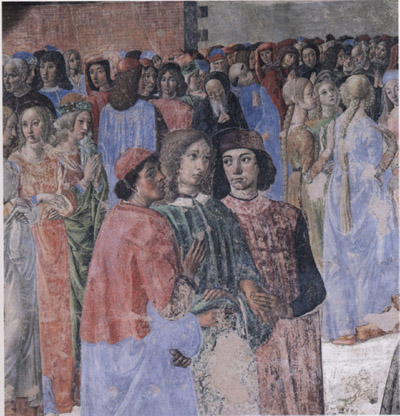
Part of a fresco from the church of San Ambrogio in Firenze, depicting Pico as he's being flanked by his jolly good friends Angelo Poliziano and Marsilio Ficino. I gotta tell ya, it's getting harder and harder to find decent pictures of the guy....

Though Pico’s ontology of the human species is not always consistent, it does follow a certain kind of inner logic. For example, in his earliest written work, a commentary on his friend Girolamo Benivieni’s poem Canzone d’Amore[1], Pico distinguishes between four specific parts that make up the human soul: the vegetative, the sensitive, the rational, and the intellectual. The Oration, written shortly afterward in this period of exceptional productivity that Pico would never again match, confirms this fourfold division, while stressing that it is the unity of man which participates in the nature and essence of all creation that allows him to be “made one with God.”

In the Heptaplus Pico lays out a more elaborate scheme of human nature, consisting of (1) the mortal body; (2) the rational soul; (3) an intervening spirit which serves to connect the soul and the body; (4) the intermediate sensual part we share with the brutes; and (5) the intelligence we share with the angels. Elsewhere in the Heptaplus Pico describes man as being made up of “a body compounded from the elements, and a heavenly spirit, and the vegetative soul of plants, and the sense of brutes, and reason, and the angelic mind, and the likeness of God.” What Pico thus identifies as essential in a human being are the characteristics we share with beings higher than ourselves (angels) and creatures on a lower step of the ladder (plants, animals), those characteristics being the intellect in the case of angels, and the vegetative soul and senses in the case of lower beings. Sometimes Pico mentions these last two together and sometimes not, being content to simply point out that we have something in common with higher as well as lower nature.

Furthermore, there is the unity of God that we emulate, and through which we are able to ultimately achieve the desired deification. Specifically, it is through Jesus Christ that the invisible God is united with His creation. The spirit that Pico talks about seems to be the spirit of life (Pico also equates it with “light”), since without it the heavens could not impart the benefits of life and motion on us. What peculiar to the human being is the rational soul, and it is through this faculty that henosis (A Neoplatonic term connoting union with the One or the ultimate Source) is achieved.

Pico departs from the accepted Aristotelian and scholastic notions which hold that reason is the highest faculty of the soul and follows the Platonists in positing an intellectual or angelic part above the rational. Through this distinction Pico is able to adhere to the Averroistic’ notion of the unicity of the intellect.[2] The Arabic philosopher Averroes (Ibn Rushd, 1126-1198) became quite notorious in the Renaissance with his theory that there is only one shared intellect for all human beings, which caused many disputes among philosophers regarding the perceived merit of this theorem. Philosophically, it was quite attractive, for it could explain the universality of intellectual knowledge, but theologically it was untenable, because it seemed to imply that there was no personal immortality after the death of the material body. Such a matter was central to Renaissance philosophy, because it touched on major questions like the eternity of truth and the capacity of the human mind to grasp this, and the way to account for human behaviour and morality.

The immortality of the soul, the defining mark of humanity, was essential to the salvation of mankind and demonstrates the inescapable link between philosophy and theology, the former often working to strengthen the latter. By positing the rational soul as the fundamental feature of human nature, Pico handily circumvents this problem. The rational soul, the medium trough which we reach to God, is personal and immortal, while the intellect provides reason with the impulse to reach above itself and strive to unity with God. What Pico thus seems to postulate is that the divine intellect illumines our soul, which eventually endeavours to go even beyond this and reach its ultimate source, God.
           
But as stated before, owing to the pull of sensual appetites the rational soul will not climb upwards to the highest chambers of heaven by its own accord, but needs to be expressly cultivated and Pico proposes a rigorous program for this. After all, “nothing can rise above itself by relying on its own strength” (Heptaplus), and the person attempting to do so has to be sagacious and morally worthy. The count of Mirandola therefore draws up a four part program, echoing the doctrines of the psychological, moral, mystical and ritual aims of philosophy expounded by Neoplatonists and early Church Fathers such as Clement of Alexandria. Simply put, we have to “compete with the angels in dignity and glory” and emulate the ways of highest three orders of angels, namely the Thrones, Cherubim and Seraphim. So we have to be of worthy opinion like the throne, who “stands in steadfastness of judgment”; of contemplative insight as the cherub, who “shines with the radiance of intelligence”; and finally, of proper dedication and love for God like the seraph, who “burns with the fire of charity” (all quotes from the Oration, as if you hadn’t guessed). Pico then moves to illustrate his curriculum by example of Saint Paul and Jacob, and fortifies it by showing its continuity with many other traditions of wisdom, such as that of the Pythagoreans, Plato and the Chaldeans.

Wow. We’re heading into truly glorious abodes now. Better wear some sunglasses or something like that next time so as not to be blinded by the sheer and utter brilliance erupting from you screen! Hoho.


[1] Pico composed this work between 10 May 1486 and 10 September 1486, after he had tried to kidnap a certain Margherita, a wealthy widow who had just remarried a minor de’Medici, but a Medici nonetheless, in Arezzo. Accounts on Margherita’s supposed willingness vary (Pico’s sister swore the lady followed her brother voluntarily), but in any case the young count was caught right before reaching Siena and was lucky to escape with his life. Pico’s retinue was not so lucky however, as some eye-witnesses held that eighteen of his men bit the dust following the reckless episode. All the same, Lorenzo de’Medici was quick to forgive this crime and Pico returned with a pious zeal to his studies.
[2] Pico states this adherence in theses 2>73 & 3>67-69. Actually belonging to the 400 statements that he presented as “not his own”, Pico amplifies Averroes’ claims in such a way as to make them his personal interpretation and it seems likely that he intended to demonstrate the concord of Averroes with Aristotelianism and Christianity.