Friday, September 9, 2011

On The Soul & Kidnapping

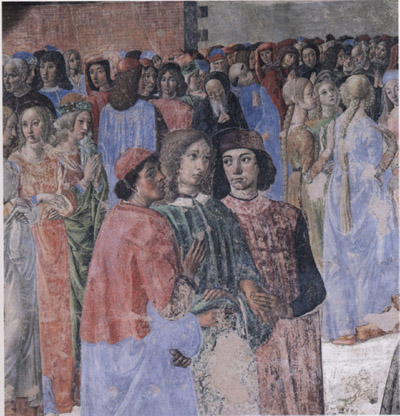
Part of a fresco from the church of San Ambrogio in Firenze, depicting Pico as he's being flanked by his jolly good friends Angelo Poliziano and Marsilio Ficino. I gotta tell ya, it's getting harder and harder to find decent pictures of the guy....

Though Pico’s ontology of the human species is not always consistent, it does follow a certain kind of inner logic. For example, in his earliest written work, a commentary on his friend Girolamo Benivieni’s poem Canzone d’Amore[1], Pico distinguishes between four specific parts that make up the human soul: the vegetative, the sensitive, the rational, and the intellectual. The Oration, written shortly afterward in this period of exceptional productivity that Pico would never again match, confirms this fourfold division, while stressing that it is the unity of man which participates in the nature and essence of all creation that allows him to be “made one with God.”

In the Heptaplus Pico lays out a more elaborate scheme of human nature, consisting of (1) the mortal body; (2) the rational soul; (3) an intervening spirit which serves to connect the soul and the body; (4) the intermediate sensual part we share with the brutes; and (5) the intelligence we share with the angels. Elsewhere in the Heptaplus Pico describes man as being made up of “a body compounded from the elements, and a heavenly spirit, and the vegetative soul of plants, and the sense of brutes, and reason, and the angelic mind, and the likeness of God.” What Pico thus identifies as essential in a human being are the characteristics we share with beings higher than ourselves (angels) and creatures on a lower step of the ladder (plants, animals), those characteristics being the intellect in the case of angels, and the vegetative soul and senses in the case of lower beings. Sometimes Pico mentions these last two together and sometimes not, being content to simply point out that we have something in common with higher as well as lower nature.

Furthermore, there is the unity of God that we emulate, and through which we are able to ultimately achieve the desired deification. Specifically, it is through Jesus Christ that the invisible God is united with His creation. The spirit that Pico talks about seems to be the spirit of life (Pico also equates it with “light”), since without it the heavens could not impart the benefits of life and motion on us. What peculiar to the human being is the rational soul, and it is through this faculty that henosis (A Neoplatonic term connoting union with the One or the ultimate Source) is achieved.

Pico departs from the accepted Aristotelian and scholastic notions which hold that reason is the highest faculty of the soul and follows the Platonists in positing an intellectual or angelic part above the rational. Through this distinction Pico is able to adhere to the Averroistic’ notion of the unicity of the intellect.[2] The Arabic philosopher Averroes (Ibn Rushd, 1126-1198) became quite notorious in the Renaissance with his theory that there is only one shared intellect for all human beings, which caused many disputes among philosophers regarding the perceived merit of this theorem. Philosophically, it was quite attractive, for it could explain the universality of intellectual knowledge, but theologically it was untenable, because it seemed to imply that there was no personal immortality after the death of the material body. Such a matter was central to Renaissance philosophy, because it touched on major questions like the eternity of truth and the capacity of the human mind to grasp this, and the way to account for human behaviour and morality.

The immortality of the soul, the defining mark of humanity, was essential to the salvation of mankind and demonstrates the inescapable link between philosophy and theology, the former often working to strengthen the latter. By positing the rational soul as the fundamental feature of human nature, Pico handily circumvents this problem. The rational soul, the medium trough which we reach to God, is personal and immortal, while the intellect provides reason with the impulse to reach above itself and strive to unity with God. What Pico thus seems to postulate is that the divine intellect illumines our soul, which eventually endeavours to go even beyond this and reach its ultimate source, God.
           
But as stated before, owing to the pull of sensual appetites the rational soul will not climb upwards to the highest chambers of heaven by its own accord, but needs to be expressly cultivated and Pico proposes a rigorous program for this. After all, “nothing can rise above itself by relying on its own strength” (Heptaplus), and the person attempting to do so has to be sagacious and morally worthy. The count of Mirandola therefore draws up a four part program, echoing the doctrines of the psychological, moral, mystical and ritual aims of philosophy expounded by Neoplatonists and early Church Fathers such as Clement of Alexandria. Simply put, we have to “compete with the angels in dignity and glory” and emulate the ways of highest three orders of angels, namely the Thrones, Cherubim and Seraphim. So we have to be of worthy opinion like the throne, who “stands in steadfastness of judgment”; of contemplative insight as the cherub, who “shines with the radiance of intelligence”; and finally, of proper dedication and love for God like the seraph, who “burns with the fire of charity” (all quotes from the Oration, as if you hadn’t guessed). Pico then moves to illustrate his curriculum by example of Saint Paul and Jacob, and fortifies it by showing its continuity with many other traditions of wisdom, such as that of the Pythagoreans, Plato and the Chaldeans.

Wow. We’re heading into truly glorious abodes now. Better wear some sunglasses or something like that next time so as not to be blinded by the sheer and utter brilliance erupting from you screen! Hoho.


[1] Pico composed this work between 10 May 1486 and 10 September 1486, after he had tried to kidnap a certain Margherita, a wealthy widow who had just remarried a minor de’Medici, but a Medici nonetheless, in Arezzo. Accounts on Margherita’s supposed willingness vary (Pico’s sister swore the lady followed her brother voluntarily), but in any case the young count was caught right before reaching Siena and was lucky to escape with his life. Pico’s retinue was not so lucky however, as some eye-witnesses held that eighteen of his men bit the dust following the reckless episode. All the same, Lorenzo de’Medici was quick to forgive this crime and Pico returned with a pious zeal to his studies.
[2] Pico states this adherence in theses 2>73 & 3>67-69. Actually belonging to the 400 statements that he presented as “not his own”, Pico amplifies Averroes’ claims in such a way as to make them his personal interpretation and it seems likely that he intended to demonstrate the concord of Averroes with Aristotelianism and Christianity.

Wednesday, September 7, 2011

Train Kept A Rollin'

Luigi Mussini, "Birthday and Parentalia of Plato, Celebrated at Villa di Careggi by Lorenzo the Magnificent", 1862. Pico can be seen in the background with his arm over the shoulder of one his philosophical sparring buddies (probably Angelo Poliziano). If you look closely you can see me standing over there by the fig tree.........no just kidding, I wasn't even born then.

All this we should keep in mind when we approach Pico’s method of philosophy and its ultimate aim of reconciling man with his divine origin. Pico’s cosmology consisted of a tripartite, or rather quadripartite structure in which all levels of reality are interlinked and each world reflects the other, although in varying degrees of perfection and fulfilment. At the highest level there is the angelic or intelligible realm, where the angels dwell and where the eternal fire of the seraphic[1] intellect burns with love for God. Below that, there is the celestial world containing all the planets, and at the bottom the sublunary world of the plants and animals which we also inhabit. God presides over the angelic domain, but at the same time he transcends it, for God is the foundation of existence out of which everything else emanates, the act of existence itself.[2]

However, there is also a fourth world which incorporates all the elements found in the others and has the ability to infringe on the terrain of all the others. This is man himself, who moreover possesses the unity and likeness of God, through which he may aspire to journey back to the godly source of existence. But man is not only the fourth world, he is also the “bond and union” of the others, and as God contains all things in himself as their origin, man contains all things in himself as their center. What Pico is thus trying to establish is the ontological supremacy of man, which consists not only of material finiteness but of incorporeal immutability as well. So when Pico adds his own episode to the creation story of Genesis in the Oration, he does so with the express purpose of justifying his idiosyncratic theurgical methods and theological opinions.

“Thou, like a judge appointed for being honourable, art the molder and maker of thyself; thou mayest sculpt thyself into whatever shape thou dost prefer. Thou canst grow downward into the lower natures which are brutes. Thou canst again grow upward from thy soul’s reason into the higher natures which are divine.”

If we are to believe Pico this is part of the speech God gave to Adam before sending him out into the world and it forms the groundwork for Pico’s subsequent philosophizing on the nature of man and his desired goals. As stated before, for Pico the ultimate source of felicity in human life consists of attaining mystical union with God, a sort of blissful ecstasy of deification in which a supernatural salvation and regeneration of the soul is obtained. There is some matter of dispute as to whether Pico meant this salvation to be personal or collective, owing to the question of Pico’s supposedly millenarian speculations on the rapidly approaching end of world, fuelled by the ominous looming of the year 1500, which was just around the corner, and perhaps also by Savonarola’s fulminating sermons. Farmer[3] interprets Pico’s work, especially the 900 theses and the Oration, as a covert plan of grand cosmic resurgence in which mankind was to be prepared for its final marriage with Christ on the eve of the Second Coming. However, Pico himself remains ambivalent on this point and we cannot know for certain. It seems more likely that Pico had in mind an individual program of philosophical preparation owing to the fact that he repeatedly stresses the importance of keeping the true religion secret and the necessity of moral and ethical purification before even attempting a mystical ascent.
           
Nevertheless, this does not mean that we should disregard the power that an event like the Second Coming could have on Pico’s mind. Pico was strictly orthodox in his faith, and there was something that drew him to Savonarola’s repeating claims of painting the invasion of Charles VIII as a punishment sent by God to eliminate moral laxity in the Church, so far that Pico forsook his worldly possessions, denounced his earlier forays into poetry and Egyptian and Chaldean (the presumed teachings of Zoroaster) wisdom and donned the black and white robes belonging to the Dominican order of which Savonarola was head in Florence. When Pico died, most certainly by poisoning, Savonarola delivered his eulogy and he was buried in the church of San Marco, the stronghold of Savonarola’s enterprise.

What emerges from all this, is the point that Pico was no religious radical, but a man perfectly in tune with the prevalent beliefs of his surroundings. But what made him unique however, was his elaborate scheme, replete with Kabbalah, of spiritual ascension as regards the moral and religious duty of man. According to Pico, the prerequisites of  this endeavour are grounded in knowledge and understanding. As creatures with the capability to move between different natures, we are able to view the world from different perspectives and judge the merit and ethical worth of each one. Even so, the most worthy choice is to aspire to God, and not to debase oneself to the lower nature of the “brutes”, the plants and animals. This is an important point to remember. Pico repeatedly stresses the fact that there is a tension inherent in the rational soul to either gravitate toward “bestial” sensation or angelic intellect. The soul of man is posed at an intermediate level between the senses, signified by appetite, and the intellect, symbolizing will. We are thus either pulled down to the level of the brutes or lifted up to the supreme abodes of the angelic intellect, depending either on our desire to satisfy our basic urges or our need for spiritual contemplation.

Oof! And there's still more coming! With a heave, and a ho!


[1] Pico adheres to Pseudo-Dionysius’s division of the 9 angelic hierarchies with the top 3 consisting of the Seraphim, Cherubim and Thrones. Who’s Pseudo-Dionysius, you say? Good question.
[2] See Pico, “On Being and the One”: “For God, who is the plenitude of all existence, is of this nature. He alone is of himself, and from him alone, with no interposing medium, all things proceed to existence.”
[3] Some guy who wrote a book about Pico’s 900 Theses. If you’re him: I liked the book, man. Really.

Monday, September 5, 2011

No Rest For The Wicked

Yes, Pico was of such precocious intelligence that he was already reading when others were still happily soiling their undergarments! Unlike you, who is doing so now whilst reading this splendid weblog.

All in all, we should do well to remember that when we enter the world of Pico della Mirandola, we enter a world profoundly different from ours. The Renaissance remains a difficult period to assess because its name alone presupposes a grand resurgence in the Western mind as it endeavours to reinstate itself in the inevitable journey towards cultural adulthood. However, it would be wrong to attempt to explain away notions of irrationality that fail to satisfy our modern understanding as unfortunate by-products of the not-yet cultivated Renaissance intellect that was on the way to attaining objective, scientific insight, but had to achieve this through trial and error. The point is that in the premodern period the cosmos still existed of many occult powers and that a closer understanding of these forces was propagated not in a sustained attempt to dispel them, but in order to better understand them and participate in their governance of the world, and eventually through this to come to a closer apprehension of the ways and beauty of God. For example, even though the Italian philosopher Pietro Pomponazzi (1462-1525) wanted to banish the belief that miracles were wrought on nature by angels and demons, he still believed that changes in the material world were caused by the occult qualities of certain stones, the torpedo fish (electric ray) and other miscellaneous objects.

Furthermore, the time that Pico lived in was one of profound political turmoil. Florence, Pico’s final resting place, was never free from internal conflict and the volatile rule of the Medici would collapse shortly after Pico’s death, fuelled in part by the fervent preaching of Girolamo Savonarola (1452-1498), the firebrand Dominican preacher whose teachings Pico had started to adhere to fanatically. Moreover, the entire Italian peninsula was marked by political instability. On the day Pico died, the French king Charles VIII entered the city, occupying it as he passed through it on his quest to claim the kingdom of Naples. Charles had been prompted into this by Innocent VIII and the Duke of Milan, but also in part by Piero the Unfortunate, Lorenzo de’Medici’s son and heir, who promised him safe passage through Tuscany. That alliances at the time were more than fluid becomes apparent in the fact that as soon as Charles VIII had conquered the crown of Naples, Milan joined the anti-French coalition, the League of Venice, spearheaded by Pope Alexander VI who wanted to get rid of the French in order to secure some prosperous fiefdoms for his children.

As an answer to all this, Pico wanted to establish a purer and more original form of Christianity and re-examine the dogmatic particulars of ecclesiastical doctrine. What set Pico apart from other humanists was his use of Kabbalah and his willingness to include scholastic reasoning in his philosophizing, a “barbaric” style that his humanist friends like Angelo Poliziano and Ermolao Barbaro (he himself was well aware of the irony of his name) scoffed at. Through the practices of Kabbalah and the theurgy of Neoplatonists and Christian mystics alike, Pico himself also aimed at a transcendental stepping beyond the material world to attain blissful, mystical union with the Godhead. Concretely, what Kabbalah offered to Pico was its rich tradition of Biblical exegesis, numerology and spiritual meditation on divine names, letters and shapes. In Heptaplus (1489) Pico offers his own Kabbalistic method of interpreting the first chapter of Genesis. The Hebrew word Beresit or berescith (“In the beginning”) is after some adding and subtracting of its Hebrew letters to form other words taken to signify: “The father, in the Son and through the Son, the beginning and end or rest, created the head, the fire, and the foundation of the great man with a good pact.” (Pico, Heptaplus) While such a laborious reading of one word might seem excessive to the casual reader it is in fact common practice for the Kabbalist, for whom this type of exegesis was a spiritual exercise intended to bring the human mind into closer communion with God. Kabbalah is foremost an interpretive mode of scriptural investigation which holds to the belief that nothing in the Torah, not even the smallest change in a letter at a particular point, lacks a deeper theological meaning.

Pico thus found in Kabbalah a welcome aid for his own spiritual purposes, namely facilitating a return to the ultimate origin of the human soul: God. Kabbalah worked as a sort of second revelation. As language is one of the chief vehicles of magic, it follows that the speech of God, in the original Hebrew, is exceptionally potent. Pico thought that in addition to the written law, Moses also received the true interpretation of this law by God while on Mount Sinai, which he was forbidden to disclose openly, but cleverly disguised “under the shell and raw face of the words”. The merit of Kabbalah was twofold for Pico: first, it ratified his belief in the prominence of Scripture as the basis for faith, because it gave access to the proper, divine way of speaking that was to be found in the Bible. Second, it confirmed his notion of the prisca theologia[1], seeing as how Moses was prohibited from mentioning the spiritual law in his writing, he did manage to transmit it orally to a succession of sages (like Zoroaster, Orpheus, Pythagoras, Plato etc.), which accounted for the principal concord of all religious and philosophical traditions with the Christian doctrine. Or at least it did in Pico’s view.[2]


[1] Pico’s philosophical sparring partner, Marsilio Ficino (1433-1499), was also enamoured with this idea, though he would frequently alter the order and appearance of his favourite “wise men”.
[2] Pico, who’s secondary aristocratic title was count of Concord, considered it his life’s work to account for the basic concord of all wisdom traditions in the light of Christianity. The conjuncture of Pico’s title with his activity only served as further confirmation of the piousness of his enterprise to him and his friends.

Friday, September 2, 2011

Back In The Saddle Again

It's our boy Pico!

The controversy surrounding Pico’s 900 theses and the Apology (1487) that he wrote to defend them poignantly reflects the religious and intellectual climate of the Renaissance. The authority of the Church, and by extension the Pope, Christ’s vicar on earth, was unquestionable and even though some tensions were beginning to show (particularly concerning the sometimes undutiful ways of ecclesiastical authority; Innocent VIII himself had two illegitimate children and frequently sold papal offices to the highest bidder) the revelation of Jesus Christ proved impossible to abandon. Of course, things would come to a head with the Reformation (1517), but even then the desire was to rebirth Christianity and not to remove religion from its dominant sphere of influence. At the time, philosophy was primarily an educative and intellectual discipline and it was used to account for the existing harmony between divine and natural law and the possibility of applying this to the order of society. It was believed that God’s order revealed itself as much in nature as it did in revelation. Despite the advent of (Neo)Platonism, spurred on by the large scale retrieval of ancient manuscripts that characterized the Renaissance, the dominant authority on matters of ethics and metaphysics remained Aristotle, whose theories had been adapted to serve Christendom by Saint Thomas Aquinas (1225-1274) and were still being fine-tuned by many new appearing commentaries and translations. In a sense, Renaissance Aristotelianism stimulated the scientific approach to nature by promoting a deduction from effects to causes, though the empirical science that we know today is a far cry from the sort of experiential investigation that the natural philosophers of the Renaissance practised.
             
Furthermore, there was the matter of magic. This was widely considered to be a serious concern and not some trivial topic of fickle self-deception or mass hallucination. Church rituals and liturgical practices, such as the Eucharist, are common examples of customs that were considered to be magical, although there was also the feared shadow side of magic, which included demonolatry and necromancy. It is no coincidence that during Pico’s heyday the Malleus Malificarum (1487), describing the malign and diabolic practices of witches, also appeared. Pico therefore took pains to distinguish his method of “natural magic” from the shameless invocation of evil demons and spirits for strictly material aims:
                                                                                                                
“I have proposed theorems about magic, too, wherein I have signified that magic is twofold. The first sort is put together by the work and authorship of demons, and is a thing, as God is true, execrable and monstrous. The other sort is, when well explored, nothing but the absolute consummation of the philosophy of nature.” (Pico, "On the Dignity of Man")

Pico’s magic, as he states to protect himself from possible accusations of demonolatry and heresy, works by marrying earth to heaven, that is, bringing together scattered forces in nature and activating them through infusion with divine virtue, and is ultimately grounded in God’s grace. The Catholic Church would often condemn magical acts because they were believed to infringe on official, sanctioned religious practices and just as often Protestants denounced Roman Catholic rituals as “demonic”. It is not surprising that in such a climate the legend of Faust would soar to extraordinary heights of popularity. The dabbling of the unfortunate doctor of theology in powers beyond his understanding and his arrogant zeal to subjugate nature to his very whim tellingly reflects the dominant mores of the time, underlining the ultimate authority of the Church and the limits of the human intellect that still has to bow to the providence and supremacy of God.

 More coming soon! For real!