Showing posts with label magic. Show all posts

Friday, September 2, 2011

Back In The Saddle Again

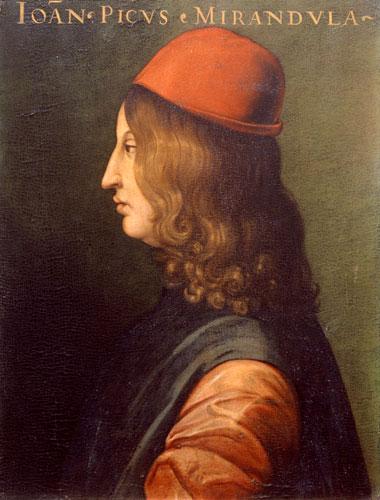
It's our boy Pico!

The controversy surrounding Pico’s 900 theses and the Apology (1487) that he wrote to defend them poignantly reflects the religious and intellectual climate of the Renaissance. The authority of the Church, and by extension the Pope, Christ’s vicar on earth, was unquestionable and even though some tensions were beginning to show (particularly concerning the sometimes undutiful ways of ecclesiastical authority; Innocent VIII himself had two illegitimate children and frequently sold papal offices to the highest bidder) the revelation of Jesus Christ proved impossible to abandon. Of course, things would come to a head with the Reformation (1517), but even then the desire was to rebirth Christianity and not to remove religion from its dominant sphere of influence. At the time, philosophy was primarily an educative and intellectual discipline and it was used to account for the existing harmony between divine and natural law and the possibility of applying this to the order of society. It was believed that God’s order revealed itself as much in nature as it did in revelation. Despite the advent of (Neo)Platonism, spurred on by the large scale retrieval of ancient manuscripts that characterized the Renaissance, the dominant authority on matters of ethics and metaphysics remained Aristotle, whose theories had been adapted to serve Christendom by Saint Thomas Aquinas (1225-1274) and were still being fine-tuned by many new appearing commentaries and translations. In a sense, Renaissance Aristotelianism stimulated the scientific approach to nature by promoting a deduction from effects to causes, though the empirical science that we know today is a far cry from the sort of experiential investigation that the natural philosophers of the Renaissance practised.
             
Furthermore, there was the matter of magic. This was widely considered to be a serious concern and not some trivial topic of fickle self-deception or mass hallucination. Church rituals and liturgical practices, such as the Eucharist, are common examples of customs that were considered to be magical, although there was also the feared shadow side of magic, which included demonolatry and necromancy. It is no coincidence that during Pico’s heyday the Malleus Malificarum (1487), describing the malign and diabolic practices of witches, also appeared. Pico therefore took pains to distinguish his method of “natural magic” from the shameless invocation of evil demons and spirits for strictly material aims:
                                                                                                                
“I have proposed theorems about magic, too, wherein I have signified that magic is twofold. The first sort is put together by the work and authorship of demons, and is a thing, as God is true, execrable and monstrous. The other sort is, when well explored, nothing but the absolute consummation of the philosophy of nature.” (Pico, "On the Dignity of Man")

Pico’s magic, as he states to protect himself from possible accusations of demonolatry and heresy, works by marrying earth to heaven, that is, bringing together scattered forces in nature and activating them through infusion with divine virtue, and is ultimately grounded in God’s grace. The Catholic Church would often condemn magical acts because they were believed to infringe on official, sanctioned religious practices and just as often Protestants denounced Roman Catholic rituals as “demonic”. It is not surprising that in such a climate the legend of Faust would soar to extraordinary heights of popularity. The dabbling of the unfortunate doctor of theology in powers beyond his understanding and his arrogant zeal to subjugate nature to his very whim tellingly reflects the dominant mores of the time, underlining the ultimate authority of the Church and the limits of the human intellect that still has to bow to the providence and supremacy of God.

 More coming soon! For real!

Tuesday, July 12, 2011

Come And Get Your Pico!

Giovanni Pico, Count of Mirandola and Concord

I hear you! I hear you, you bunch of red hot, overzealous fanatics! You have been so eager in the search for ultimate truth that you have been pursuing me relentlessly for tiny scraps of the gargantuan knowledge that I keep locked inside my gallant brain. You have been clamoring at me, begging me, pleading me, entreating me, imploring me, beseeching me to share my prolific understanding with you and raise your inapt intellects to some more elevated (yet still decidedly humble) heights. At times it has been quite pathetic. But I am not one to judge or hold in disdain, thrustworthy followers! Here is the unabridged text that laid the basis for my first advent into the public gaze! Never again waste away tears, sobbing about how you would like to know more about Pico della Mirandola and Renaissance philosophy! It will all be periodically laid out for you in the coming days! FOR FREE!* Starting now:

“Let a certain holy ambition invade the mind, so that we may not be content with mean things but may aspire to the highest things and strive with all our forces to attain them: for if we will to, we can. Let us spurn earthly things; let us struggle toward the heavenly. Let us put in last place whatever is of the world; and let us fly beyond the chambers of the world towards the most lofty divinity.” 

Strong, haughty words and elegant humanist rhetoric are what characterize Giovanni Pico della Mirandola’s (1463-1494) renowned Oration (1486), often carrying the further designation On the Dignity of Man, though its author never intended to add this extra heading and it expressly misses the thought underlying the original text. The Oration has been hailed as one of the defining texts of the Renaissance because it supposedly celebrates notions of human dignity and freedom and inspired the progression of the human intellect towards superior reason and the uncovering of the laws of nature. However, such a misreading was the result of a centuries-long process in philosophy which intended to reframe its illustrious history in Kantian terms, stressing the opposition between the passive reception of phenomenal nature and the noumenal freedom of the human mind to rise above this and eventually perceive the “thing-in-itself”, i.e. reality as it actually is. 

This approach remained fashionable until at least the middle of the previous century, while at present Pico’s text is more generally recognized for what it really is: the introductory speech for the great public debate of 1487 in Rome, where the then 23 years old Pico intended to take on all comers in a dispute resolving the most vexing questions in magic, philosophy and theology and during which the young count of Mirandola wanted to defend his belief in the long chain of knowledge running through all ancient wisdom traditions (the prisca theologia) and the quintessential role of Kabbalah (Pico himself spelled it “Cabala”) in the illumination of Christian religion and salvation. Pico had drafted 900 specific propositions** for this occasion, ranging in subject matter from the nature of intelligible images to Christ’s descent into Hell to Egyptian symbolism in the Kabbalah. Sadly this proposed debate would never come about because a papal commission denounced thirteen of Pico’s theses and considered three of these to be explicitly heretical. 

This led Pico to hastily write a defence, his Apology (1487), in which he attempted to justify the condemned propositions and offer some explanatory insights on the nature of heresy, its relation to matters of faith (namely, what is put forth in Scripture) and opinion (the insights of the Church Fathers) and thus ultimately the authoritative basis of Christian religion. In reaction to this Pope Innocent VIII put Pico under inquisitional observance and eventually denounced all the nine hundred theses and prohibited their use and distribution under threat of excommunication. The brash Pico therefore stole off to Paris, but at the Pope’s request he was there apprehended by the authorities and jailed. The timely intervention of Lorenzo de’Medici saved him however, and by the next year he was back safely in Tuscany, taking up residence in a villa in Fiesole provided to him by Lorenzo “the Magnificent”.

To be continued.....

*I am of course not responsible for any damaging influence that this text can have on the relatively poor quality of your grey mass, such as a sudden enlargment of the dorsolateral prefontal lobe (where the executive and logical functions are housed, natch).

**Nowadays commonly referred to as the 900 Theses or Conclusions (1486), Pico’s original publication of December 1486 carried no title, most probably because it was meant as a guide book accompanying the debate and not a pleasant read for long, cold winter nights.